


Pope Francis says he will tell Azerbaijanis the truth of what he has seen in Armenia
27.06.2016,
16:55
On his flight back to Rome following his three-day Apostolic Voyage to Armenia Pope Francis spoke to reporters and one of the questions was about his planned visit to Azerbaijan in some weeks.
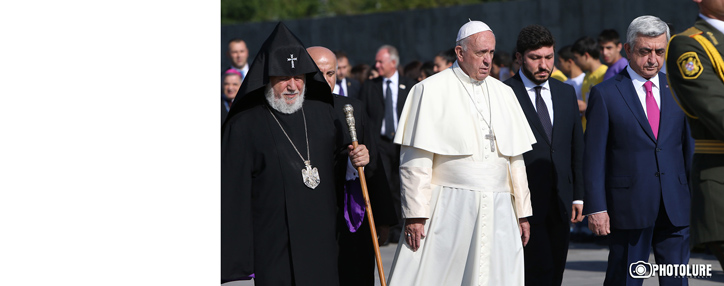
YEREVAN, June 27. /ARKA/. On his flight back to Rome following his three-day Apostolic Voyage to Armenia Pope Francis spoke to reporters and one of the questions was about his planned visit to Azerbaijan in some weeks. The reporter asked Pope what is the sign he would like to give to Azerbaijan, like the one he has given to Armenia?
The Pope said he will speak to the Azerbaijanis of the truth of what he has seen, of what he has felt and that he will also encourage them.
‘I met the Azerbaijani president and I spoke with him… I’ll tell you also that not making peace for a little piece of land, because it’s not a big deal, means something dark. But I say this to all the Armenians and the Azerbaijanis. Possibly, they can’t agree on the ways of making peace, and on this they need to work. But I don’t know what else to say. I will say that at the moment it comes to my heart, but always positively trying to find solutions that are viable, that move ahead.”
Pope Francis also spoke about his use of the word ‘genocide,’ acknowledging the legal import of the expression, but explaining that this was the term commonly in use in Argentina for the massacre of Armenians during the first World War.
Pope Francis was also asked what will be his message for the future and his prayers for Armenia.
’Let’s think to the future and then let’s go to the past. I hope for justice and peace for this people and I pray for this, because it is a courageous people. And I pray that they find justice and peace. I know that so many are working for this; and also I was very happy last week when I saw a photograph of President Putin with the two Armenian and Azerbaijani presidents… at least they’re speaking! And also with Turkey and the president of the republic in his welcoming speech spoke clearly, he had the courage to say: let’s come to an agreement, forgive each other, and look to the future. And this is a great courage for a people who has suffered so much. It’s the icon of the Armenian people.’
In a joint statement released after the June 20 meeting in Russian St. Petersburg, mediated by Russia’s Putin, the presidents of Armenia and Azerbaijan confirmed their commitment to the agreements reached in Vienna on May 16 and agreed to continue trilateral talks on the Karabakh settlement aimed at stabilization of the situation in the conflict zone and to create the atmosphere favorable for promoting the peace process. They also agreed to increase the number of international observers in the conflict zone.
The presidents expressed their satisfaction with the continuing ceasefire regime on the contact line.
The Nagorno-Karabakh conflict erupted into armed clashes after the collapse of the Soviet Union in the early 1990s as the predominantly Armenian-populated enclave of Azerbaijan sought to secede from Azerbaijan and declared its independence backed by a successful referendum.
On May 12, 1994, the Bishkek cease-fire agreement put an end to the military operations. A truce was brokered by Russia in 1994, although no permanent peace agreement has been signed. Since then, Nagorno-Karabakh and several adjacent regions have been under the control of Armenian forces of Karabakh.
Nagorno-Karabakh is the longest-running post-Soviet era conflict and has continued to simmer despite the relative peace of the past two decades, with snipers causing tens of deaths a year.
On April 2, 2016, Azerbaijan launched military assaults along the entire perimeter of its contact line with Nagorno-Karabakh. Four days later a cease-fire was reached. --0---
