

Some Eurasian Economic Union members’ refusal to travel to Yerevan undermines organization’s reputation - Sargsyan
08.04.2016,
11:22
Refusal of some members of the Eurasian Economic Union to come to Yerevan for a prime-ministerial summit has undermined reputation of this organization, Serzh Sargsyan, Armenian president, said Thursday as met with Dmitry Medvedev, Russian prime minister in Yerevan.
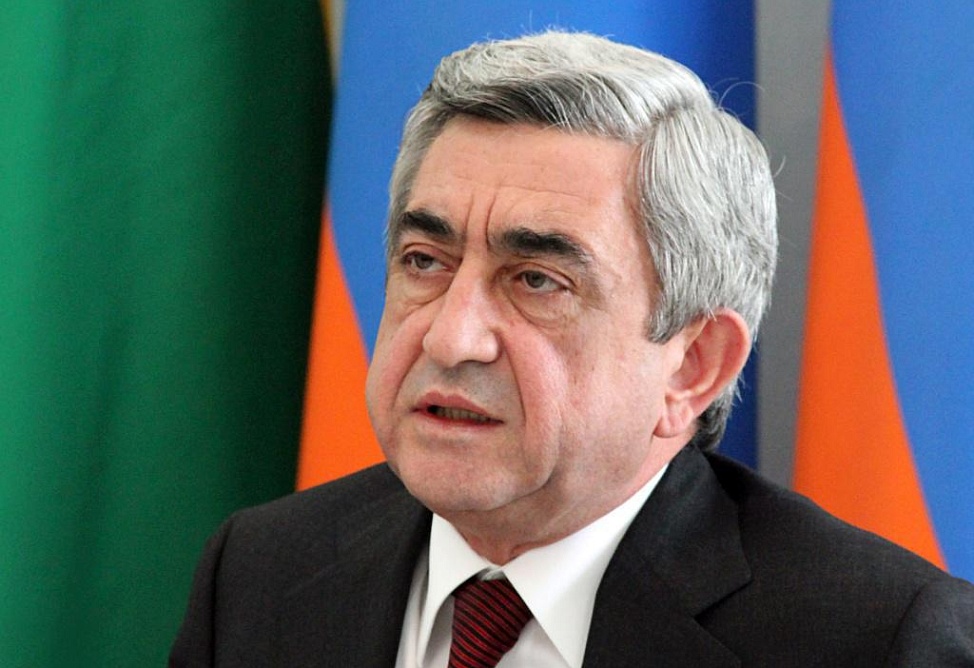
YEREVAN, April 8. /ARKA/. Refusal of some members of the Eurasian Economic Union to come to Yerevan for a prime-ministerial summit has undermined reputation of this organization, Serzh Sargsyan, Armenian president, said Thursday as met with Dmitry Medvedev, Russian prime minister in Yerevan.
It became known earlier that the summit that due to be hosted by Yerevan on April 8 was postponed to April 13 and will be held in Moscow, not Yerevan, after Kazakh premier refused to travel to Armenia’s capital city saying that this might be considered as support for one of the sides conflicting over Karabakh.
Hovik Abrahamyan, Armenian prime minister, found this conduct unacceptable stressing that there were no grounds for canceling the Yerevan meeting.
At his meeting with Medvedev, Sargsyan voiced regret at Kazakhstan’s refusal to travel to Yerevan.
“I don’t know how much they helped Azerbaijan, but it is obvious that they undermined our organization’ reputation,” he said.
Medvedev, in response, said that he will talk to the partners on the Eurasian Economic Union.
“Maybe it is possible to understand to a certain extent their conduct, since not everybody is well-informed about what is going on, what may happen and what will happen,” he said. “It is important now not to lose momentum and not to create artificial problems.”
And therefore, he said, when prospects for integration cooperation were discussed in Yerevan, it was decided to hold a prime-ministerial meeting in Yerevan very soon, “since our meetings are rare”.
“We had an arrangement to meet once in every two months, but our last meeting took place six month ago,” Medvedev said. “Therefore, I would like to build up the frequency, especially tanking into account some frustration that emerged as a result of cancellation of the meeting.”
The Nagorno-Karabakh conflict broke out in 1988 February when the Nagorno-Karabakh autonomous region announced its secession from Azerbaijan. In September 1991, the region declared itself the Nagorno-Karabakh Republic and, over the course of the enduring conflict, Azerbaijan subsequently lost control of the region.
In 1994, a Russia-brokered cease-fire was signed and peace talks have been held since, mediated by the OSCE Minsk Group.
On April 2, 2016 Azerbaijan resorted to an "unprecedented provocation along the entire perimeter of the contact line" with Nagorno-Karabakh. According to the NKR Defense Army, during the three-day fighting they have destroyed 2 helicopters, 29 tanks, one missile system Grad, heavy flame-throwing systems TOS-1, 6 armored vehicles, including 1 infantry fighting vehicle, 1 unit of engineering machinery and 6 Azerbaijani drones killing also over 300 Azeri soldiers.
The Armenian side lost 7 tanks, 20 servicemen were killed, and 72 wounded. Four civilians, including one child, were killed as well. Armenians also have 26 missing people. A ceasefire agreement was reached Tuesday at 12:00. --0---