

April 24 marks 109th anniversary of Armenian Genocide in Ottoman Turkey
YEREVAN, April 24. /ARKA/. Today, on April 24, Armenia and many other countries mark the 109th anniversary of the first genocide of the 20th century committed by the government of the Ottoman Empire during World War I, exterminating about 1.5 million ethnic Armenians.
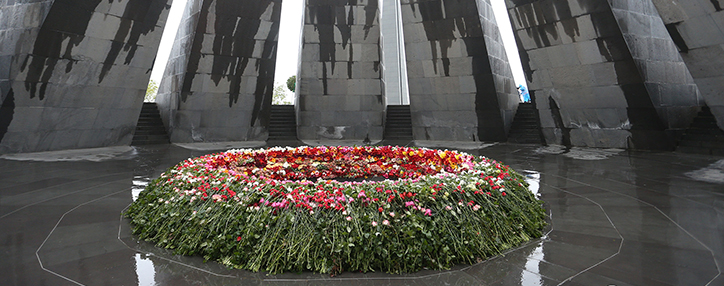
By tradition, hundreds of thousands of Armenians, starting from the evening of April 23, go up to the Tsitsernakaberd memorial complex in Yerevan and lay flowers at the Eternal Flame and remember the victims of the genocide.
The day before, a traditional torch procession organized by the youth wing of ARF Dashnaktsutyun party took place in Yerevan. Thousands of mostly young people, holding lighted torches and candles in their hands marched from Republic Square in central Yerevan to Tsitsernakaberd Memorial.
Turkey rejects accusations of mass extermination 1.5 million Armenians reacting extremely painfully to criticism from the West on the issue of the Armenian Genocide.
The Armenian Genocide has been recognized by many countries and a number of international organizations. The first country to recognize the Genocide in 1965 was Uruguay. Others are Cyprus, Russia, Greece, Canada, the Chamber of Deputies of Italy, Lebanon, Belgium, France, Paraguay, Argentina, Sweden, Bolivia, Great Britain, Holland, Slovakia, Germany, Lithuania, Venezuela, Poland, Chile, Switzerland, Brazil, Luxembourg, Austria, Vatican City, Czech Republic, Denmark, Portugal, as well as the provisional government of Libya, 49 states and both houses of the U.S. Congress, Syria, the European Parliament, and the World Council of Churches.
In a message issued on this occasion, Prime Minister Nikol Pashinyan says: ‘What should we do and what should we not do in order to overcome the trauma of genocide and exclude it as a threat? These are the questions that should be the key subject of discussion in our political and philosophical thinking, but this kind of point of view of dealing with the fact of the Meds Yeghern (as Armenians call the Genocide) is not common among us.
This is an imperative, an urgent imperative, and we must evaluate the relations between the Meds Yeghern and the First Republic of Armenia, we must relate the perception of the Meds Yeghern with the vital interests of the Republic of Armenia, our national statehood.
Meds Yeghern, deprivation of homeland is not a verdict for us, which we have to bear as a continuous search for a lost homeland. We must stop the searches of a homeland, because we have found that homeland, our Promised Land, where milk and honey flow. For us, the commemoration of the martyrs of the Meds Yeghern should not symbolize the lost homeland, but the found and real homeland, in the person of the Republic of Armenia, whose competitive, legitimate, thoughtful and creative policies can exclude a repetition.
Never again. We should not say this to others, but to ourselves. And this is not an accusation against us at all, but a point of view where we, only we, are responsible and the director of our destiny and we are obliged to have enough mind, will, depth and knowledge to carry that responsibility in the domain of our sovereign decisions and perceptions.’-0-