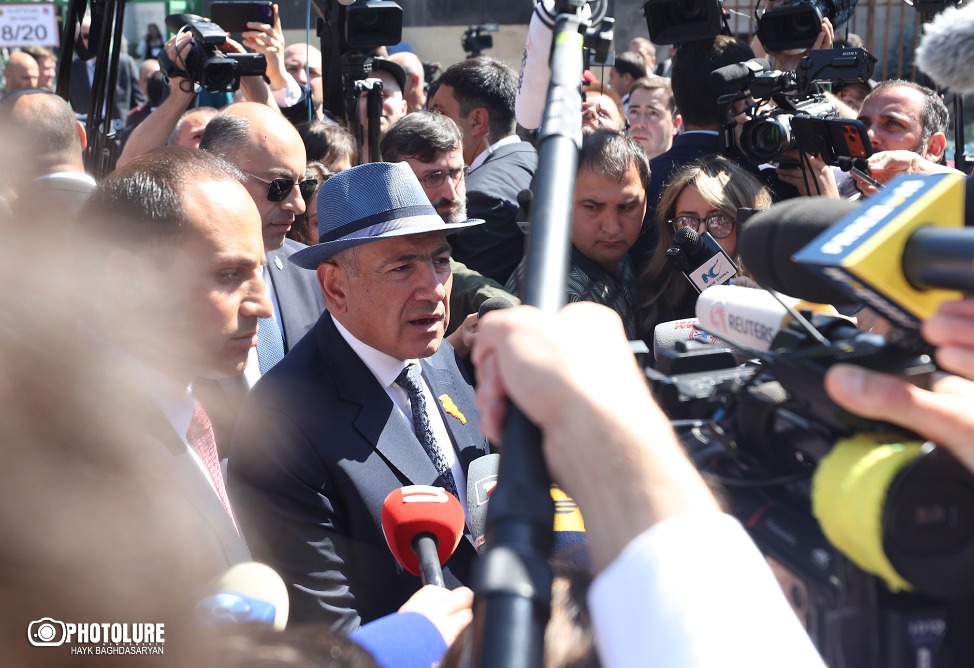


Armenian prime minister explains why he agreed to take the post
21.04.2018,
18:38
In a response letter to an open letter addressed to Armenian prime minister Serzh Sargsyan by a group of Armenian graduates of foreign universities, Sargsyan presented the reasons why he agreed to become Armenia’s prime minister after serving two terms as president.

YEREVAN, April 21. /ARKA/. In a response letter to an open letter addressed to Armenian prime minister Serzh Sargsyan by a group of Armenian graduates of foreign universities, Sargsyan presented the reasons why he agreed to become Armenia’s prime minister after serving two terms as president.
The open letter to the prime minister was signed by 61 Armenian citizens who graduated from prestigious foreign universities with the financial support from the Luys Foundation. In their letter they asked Sargsyan to resign.
In the response letter Sargsyan says the main reason why he agreed to be nominated for the post of prime minister by his Republican Party of Armenia was the need to ensure Armenia's security.
"The decision was due to one circumstance: in our geopolitically complex region and in a period full of challenges, we are obliged to ensure the country's safe development and continue efforts aimed at a worthy resolution of the Nagorno-Karabakh problem," Sargsyan said. He noted that the problems raised by the authors of the letter are resolvable, and once they are resolved, other people may govern the country.
In a statement issued earlier today Serzh Sargsyan said mass street protests were e fraught with unpredictable consequences, endangering the public order, and could undermine the complex and subtle harmony of Armenian society.
‘Each of us must remember that besides him, there are other citizens of Armenia who are not less proud of their civic stance; who live, learn, work and rest in this country. Our country’s social harmony should be based on cohesion and tolerance. I am deeply concerned about the inner-political developments. In order to avoid irreparable losses, I am urging National Assembly member Nikol Pashinyan to accept our call of political dialogue and joint the table of negotiations. It should be done immediately. I am confident that all the political forces of our country can contribute to the launch of such a dialogue adequate to the situation.
However, Pashinyan responded that the only issue he could discuss with the authorities was Sargsyan’s resignation, after which other terms, which should be acceptable not for him, but for the people, could be discussed
The anti-government protests in Armenia began on April 13 after Armenia's ruling Republican Party nominated former president Serzh Sargsyan for the prime minister’s post. Serzh Sargsyan resigned as president on April 9 and was elected as prime minister during a special session of parliament on April 17 by a vote of 77 to 17.
According to Armenia’s amended its constitution, approved in a national referendum in 2015, Armenia has switched the government from a semi-presidential to a parliamentary system making the presidency largely ceremonial and strengthening the office of the prime minister.
The protests are led by Nikol Pashinyan, the head of the opposition Yelk parliamentary faction, who declared April 17 the beginning of popular, non-violent "velvet revolution" urging demonstrators to keep besieging ministries, the prosecutor's office, the central bank and other governmental buildings.-0-
The open letter to the prime minister was signed by 61 Armenian citizens who graduated from prestigious foreign universities with the financial support from the Luys Foundation. In their letter they asked Sargsyan to resign.
In the response letter Sargsyan says the main reason why he agreed to be nominated for the post of prime minister by his Republican Party of Armenia was the need to ensure Armenia's security.
"The decision was due to one circumstance: in our geopolitically complex region and in a period full of challenges, we are obliged to ensure the country's safe development and continue efforts aimed at a worthy resolution of the Nagorno-Karabakh problem," Sargsyan said. He noted that the problems raised by the authors of the letter are resolvable, and once they are resolved, other people may govern the country.
In a statement issued earlier today Serzh Sargsyan said mass street protests were e fraught with unpredictable consequences, endangering the public order, and could undermine the complex and subtle harmony of Armenian society.
‘Each of us must remember that besides him, there are other citizens of Armenia who are not less proud of their civic stance; who live, learn, work and rest in this country. Our country’s social harmony should be based on cohesion and tolerance. I am deeply concerned about the inner-political developments. In order to avoid irreparable losses, I am urging National Assembly member Nikol Pashinyan to accept our call of political dialogue and joint the table of negotiations. It should be done immediately. I am confident that all the political forces of our country can contribute to the launch of such a dialogue adequate to the situation.
However, Pashinyan responded that the only issue he could discuss with the authorities was Sargsyan’s resignation, after which other terms, which should be acceptable not for him, but for the people, could be discussed
The anti-government protests in Armenia began on April 13 after Armenia's ruling Republican Party nominated former president Serzh Sargsyan for the prime minister’s post. Serzh Sargsyan resigned as president on April 9 and was elected as prime minister during a special session of parliament on April 17 by a vote of 77 to 17.
According to Armenia’s amended its constitution, approved in a national referendum in 2015, Armenia has switched the government from a semi-presidential to a parliamentary system making the presidency largely ceremonial and strengthening the office of the prime minister.
The protests are led by Nikol Pashinyan, the head of the opposition Yelk parliamentary faction, who declared April 17 the beginning of popular, non-violent "velvet revolution" urging demonstrators to keep besieging ministries, the prosecutor's office, the central bank and other governmental buildings.-0-