


Pashinyan-Putin meeting to paper over differences between two countries
07.09.2018,
14:44
The meeting of Armenian Prime Minister Nikol Pashinyan and Russian President Vladimir Putin, scheduled for September 8 in the Kremlin, will paper over a string of differences that have arisen in the bilateral relations, Ruben Safrastyan, the director of the Institute of Oriental Studies of the Armenian National Academy of Sciences, said today.
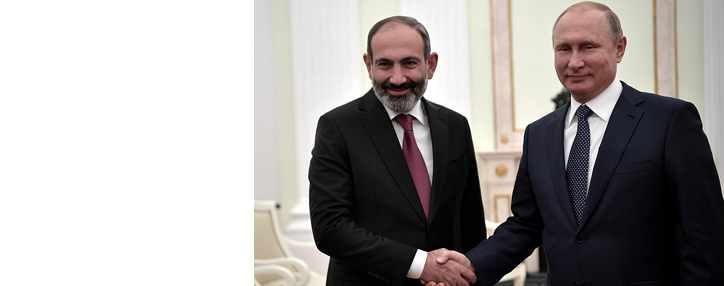
YEREVAN, September 7. /ARKA/. The meeting of Armenian Prime Minister Nikol Pashinyan and Russian President Vladimir Putin, scheduled for September 8 in the Kremlin, will paper over a string of differences that have arisen in the bilateral relations, Ruben Safrastyan, the director of the Institute of Oriental Studies of the Armenian National Academy of Sciences, said today.
"Russian-Armenian relations are facing serious challenges, and today decisive steps are needed to preserve their high level," Safrastyan told journalists. According to him, critical stories in Russian media about developments in Armenia, as well as statements by Russian Foreign Minister Sergey Lavrov about the latest steps of the Armenian government, indicate that Russia’s top leaders get the wrong idea about the ongoing processes in Armenia.
"We hope that the upcoming meeting will once again confirm that Armenia's foreign policy of developing close allied relations with Russia has not changed. We believe that the Armenian side will be able to convey this to Russian leadership," Safrastyan said.
According to Safrastyan, Russian top leadership should not worry about Armenia’s periodic rapprochement with NATO or the West, as there is no alternative for the Armenian people to the military-strategic partnership with Russia.
"For Armenia there is no alternative to the military cooperation with Russia, including within the framework of the Collective Security Treaty Organization. History has shown that our expectations from Western partners can not guarantee our security. We have strong Armenian communities in the United States and other Western countries, however, when it comes to military cooperation and real security guarantees, they can not replace Russia," he said.
According to Safrastyan, cooperation with NATO and other Western international structures develops in the areas of regional security, economy, human rights and others.
On July 31 Russian Foreign Minister Sergey Lavrov said that Russia was worried that the situation in Armenia was still boiling. Earlier top Russian officials made it clear that Moscow was concerned over the new Armenian government’s latest move, including prosecution of former president Robert Kocharyan and a former deputy defense minister Yuri Khachaturov, the current secretary general of the Russian-led Collective Security Treaty Organization. -0-
"Russian-Armenian relations are facing serious challenges, and today decisive steps are needed to preserve their high level," Safrastyan told journalists. According to him, critical stories in Russian media about developments in Armenia, as well as statements by Russian Foreign Minister Sergey Lavrov about the latest steps of the Armenian government, indicate that Russia’s top leaders get the wrong idea about the ongoing processes in Armenia.
"We hope that the upcoming meeting will once again confirm that Armenia's foreign policy of developing close allied relations with Russia has not changed. We believe that the Armenian side will be able to convey this to Russian leadership," Safrastyan said.
According to Safrastyan, Russian top leadership should not worry about Armenia’s periodic rapprochement with NATO or the West, as there is no alternative for the Armenian people to the military-strategic partnership with Russia.
"For Armenia there is no alternative to the military cooperation with Russia, including within the framework of the Collective Security Treaty Organization. History has shown that our expectations from Western partners can not guarantee our security. We have strong Armenian communities in the United States and other Western countries, however, when it comes to military cooperation and real security guarantees, they can not replace Russia," he said.
According to Safrastyan, cooperation with NATO and other Western international structures develops in the areas of regional security, economy, human rights and others.
On July 31 Russian Foreign Minister Sergey Lavrov said that Russia was worried that the situation in Armenia was still boiling. Earlier top Russian officials made it clear that Moscow was concerned over the new Armenian government’s latest move, including prosecution of former president Robert Kocharyan and a former deputy defense minister Yuri Khachaturov, the current secretary general of the Russian-led Collective Security Treaty Organization. -0-