

Presidential candidate says he is back home for good
30.01.2018,
18:11
Armenia’s ambassador to UK Armen Sarkissian, nominated by the governing Republican Party of Armenia for the presidency, told journalists that he has never left Armenia.
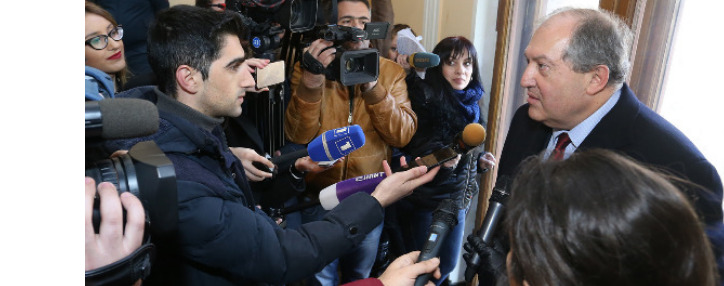
YEREVAN, January 30. /ARKA/. Armenia’s ambassador to UK Armen Sarkissian, nominated by the governing Republican Party of Armenia for the presidency, told journalists that he has never left Armenia.
"I have returned for good, although I never left Armenia," Sarkissian said today before meeting with representatives of the scientific community at the National Academy of Sciences. Sarkissian declined to announce whether he would accept the offer to become the fourth president of Armenia.
"Now I'm participating in very busy working meetings. When I'm determined, I will announce it,” Sarkissian said.
Under a package of constitutional reforms, endorsed in a national referendum in 2015, Armenia will change the governance system of the country from a semi-presidential to a parliamentary republic in 2018 April after president Sargsyan steps down.
The president of Armenia, whose powers will be significantly curtailed, will be elected for a term of seven years (instead of the current five) by the parliament, not in a national vote. Presidents will be limited to one term of office.
To be elected in the first round the candidate must be backed by three-fourths of votes. If this cannot be done, the candidate must be elected by three-fifths of votes. According to the new constitution, the president of Armenia will be head of state, embodying national unity and ensuring the observance of the Constitution. The president cannot be a member of a political party.
Under the approved changes the president is to appoint a candidate for prime minister from the party or party bloc that wins parliamentary elections. If parliamentary forces are unable to agree on the candidacy of the head of government, parliament is to be dissolved. A vote of no-confidence in the prime minister can be passed no sooner than a year after their appointment. The armed forces are subordinated to the government, and the prime minister is the supreme commander of the armed forces in times of war.-0---
"I have returned for good, although I never left Armenia," Sarkissian said today before meeting with representatives of the scientific community at the National Academy of Sciences. Sarkissian declined to announce whether he would accept the offer to become the fourth president of Armenia.
"Now I'm participating in very busy working meetings. When I'm determined, I will announce it,” Sarkissian said.
Under a package of constitutional reforms, endorsed in a national referendum in 2015, Armenia will change the governance system of the country from a semi-presidential to a parliamentary republic in 2018 April after president Sargsyan steps down.
The president of Armenia, whose powers will be significantly curtailed, will be elected for a term of seven years (instead of the current five) by the parliament, not in a national vote. Presidents will be limited to one term of office.
To be elected in the first round the candidate must be backed by three-fourths of votes. If this cannot be done, the candidate must be elected by three-fifths of votes. According to the new constitution, the president of Armenia will be head of state, embodying national unity and ensuring the observance of the Constitution. The president cannot be a member of a political party.
Under the approved changes the president is to appoint a candidate for prime minister from the party or party bloc that wins parliamentary elections. If parliamentary forces are unable to agree on the candidacy of the head of government, parliament is to be dissolved. A vote of no-confidence in the prime minister can be passed no sooner than a year after their appointment. The armed forces are subordinated to the government, and the prime minister is the supreme commander of the armed forces in times of war.-0---