


Why media are not required to publish every press release. And why that's oK
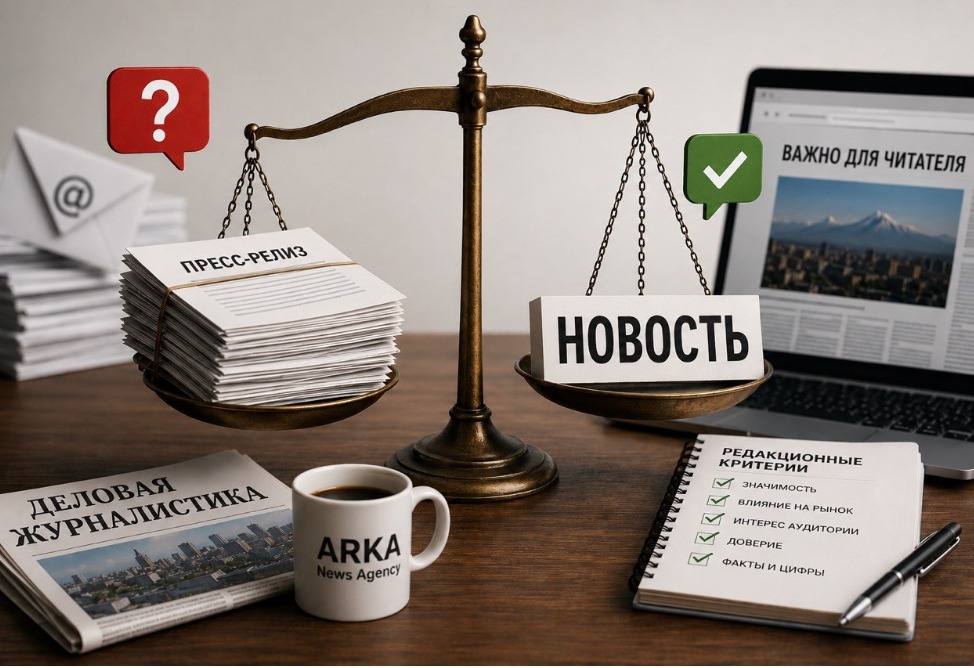
YEREVAN, July 6. /ARKA/. Almost every business media outlet is familiar with the same situation: a company sends out a press release, and an hour later asks, "Why didn't you publish our news?" Often followed by, "How much does it cost to publish?"
These questions stem from a common misconception: the mere fact of preparing a press release automatically makes it news and entitled to free publication. But a press release isn't news.
News isn't born in PR department
A press release is an official company document. News is an editorial decision. Editorial offices receive dozens, sometimes hundreds, of press releases daily. Most of them are dedicated to events that are primarily important to the company itself: a new office opening, a director being appointed, a new product being introduced, a logo being updated, a corporate event, or the company receiving an award.
For company employees, these are important events, but not always so for readers of a business media outlet. The editorial team asks itself a simple question: why should this information be important to our audience? If there is no convincing answer, it will likely not be published.
Media outlets work for reader, not for press services
The editorial team's primary goal is not to publish every incoming press release, but to select truly significant information. The editorial policy of quality media is built around the interests of the audience, not the expectations of the company.
If an event is important for the market, the economy, or society, it becomes news. If the material is a story about the benefits of a company or its product, it is already commercial communication, and a completely different scenario applies here.
International Practice
All over the world, there's a distinction between editorial publications and commercial materials: major news agencies make publication decisions based on their own editorial criteria, not the wishes of the submitting companies.
In international PR practice, there's the concept of earned media—free editorial coverage that a company receives thanks to a significant news item, not the mere fact of sending out a press release. Therefore, the goal of a professional PR service isn't to write more press releases, but to create more news items that, in and of themselves, deserve media attention.
Where is the line between news and advertising?
Very often, press releases contain overtly promotional statements: "we are the best," "our product is unique," "we offer the most favorable terms." Such statements are appropriate in advertising, but they don't constitute news, and by publishing them for free, editors are essentially providing advertising space without compensation, which is an unsustainable model. This is precisely why commercial publications, native projects, partner materials, and advertising formats exist worldwide.
Media outlets also need to make money
Sometimes you hear, "It costs you nothing just to publish our material." But try applying this logic to another business: can you go to a restaurant and ask for a free meal, because "it costs nothing to cook another portion"?
Behind every published piece of news are journalists, editors, photographers, developers, servers, software, and other costs that are invisible to the reader but integral to the editorial process. Quality journalism has never been free to produce, so media outlets, like any company, must have a sustainable business model.
Financially sustainable media outlets are, first and foremost, independent media outlets: by generating their own income, editorial staff are less dependent on sponsors, political structures, advertisers, or grants that can influence editorial policy. Such independence benefits not only editorial staff, but also the government, society, and businesses themselves, which need reputable platforms that enjoy the trust of readers.
By placing information in a professional media outlet, a company receives not just publication, but also the audience's trust, which the publication has built over years. Therefore, it's important for businesses to consider not only how to get into the media, but also which one: publication in a reputable publication builds a company's reputation far more powerfully than dozens of articles on little-known platforms with questionable editorial policies. Relationships between businesses and quality media aren't about buying publications, but rather an investment in trust, one of the most valuable assets for both parties.
Relationships should be partnerships
Media and businesses need each other: companies create products, invest, build businesses, and develop the economy, and the media communicate these developments to the public.
But partnership is impossible if one party feels indebted to the other. Editors are not obligated to publish every press release for free. However, a quality media outlet will never ignore truly important news simply because it comes from a company, if the news is of interest not only to the company but also to its readers.
How to get featured in ARKA news feed for free
ARKA news agency operates on a simple principle: we publish materials for free that have independent informational value and are of interest to our audience. For example:
• Investments in projects worth at least $1 million
• Company financial results with specific figures and trends
• Signing of major agreements that could impact an industry or market
• Launch of new production facilities, enterprises, or infrastructure projects
• Company entry into new markets
• Large-scale technology projects
• News significant for the Armenian economy, business, or investors
• Prompt expert commentary from executives on current affairs
• Changes in the financial market
How to become an expert source
Let's look at some examples: The Central Bank of Armenia changed the refinancing rate, the dollar exchange rate changed sharply, or a major geopolitical event occurred. Sources of this information should not wait for the editorial staff to request comment; it is better to independently prepare a short, professional commentary that does not advertise the company and promptly send it to the editorial staff. This is how companies gradually become permanent experts for the media: editorial offices begin to turn to them themselves, knowing that these experts quickly respond to events and provide informative assessments.
A small example from our practice
Not long ago, our editorial team sent a questionnaire to several financial companies about the state of the brokerage market in Armenia, with the aim of preparing an analytical piece useful to the entire market. Completing the questionnaire was free and required only a short time. Only five companies responded. The rest, although they did not formally refuse, simply did not have the time to participate for free in a piece that would benefit the entire industry, including themselves.
This is a good example of how businesses eagerly seek media attention but are not always willing to invest their own time in content that doesn't directly promote their product. Yet it is precisely this kind of participation—expert commentary, responses to editorial inquiries, and a willingness to share data that leads to free publication.
This approach independent expert opinion and prompt response to editorial inquiries is much more effective than regularly sending out press releases about internal corporate events of interest only to the company itself. Furthermore, a press release should be factual, not promotional: the more specific figures, analysis, and market impact it contains, the higher the likelihood of publication. And one more piece of advice: if you want to build long-term relationships with the media, don't just use your editorial team when you need to talk about a new product. Share your industry expertise and help explain complex economic processes. This kind of collaboration is valued far more than just another sales press release.
If your company's goal is to promote a product, service, or brand, we are ready to offer effective commercial tools: native publications, special projects, interviews, multimedia formats, and advertising campaigns.
We are genuinely interested in highlighting the achievements of Armenian businesses. But for this to happen, the news must be interesting not only to the author of the press release, but to our thousands of readers. A strong media economy is one of the prerequisites for independent journalism, which creates a win-win environment: businesses receive the attention they deserve, the media receive high-quality content, and readers receive truly important information.
A partnership between the media and businesses begins not with the question, "Why didn't you publish our press release?" but with the question, "How will our information be useful to your readers?" This is the question that creates real news.
Konstantin Petrosov,
Director of the ARKA news agency
