

Armenia preparing to build a new ANPP: what is known about its plans until 2041
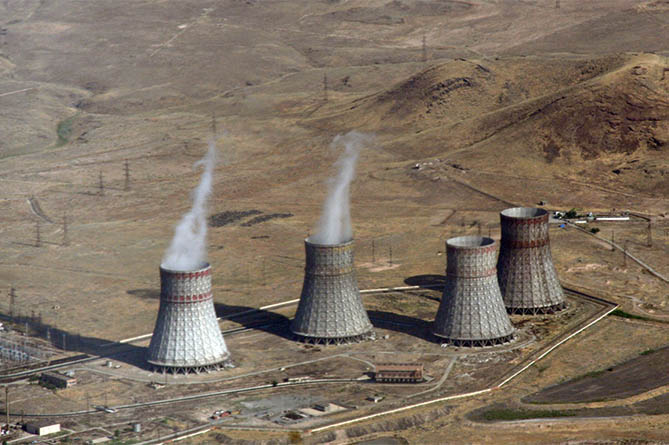
YEREVAN, September 17. /ARКА/. Armenia is simultaneously implementing a program to extend the operation of Unit 2 of the Armenian Nuclear Power Plant (ANPP) and preparing for the construction of a new nuclear power unit. The primary target for the existing plant is 2036. However, the technical plan approved by the government includes work to justify the feasibility of operating the unit's irreplaceable and non-repairable components until 2041.
On September 9, ANPP Director General Eduard Martirosyan announced that the plant was already conducting individual calculations with a target date of 2041. According to him, the current license is valid until 2031, and an extension to 2036 is being considered, as well as for a longer period if technical and regulatory justifications are met.
At the same time, the government must determine the technology for the new power unit. According to the Armenian government's program for 2026–2031, the model has already been determined, and the technology should be selected by at least the end of 2027.
ARKA News Agency investigated the meaning of the deadlines mentioned in the documents and how the extension of the existing NPP's lifespan relates to plans for the construction of a new one.
Until what year is the existing NPP planned to be operated?
The main target date of the state program is 2036. In September 2023, the government, by Decision No. 1597-A, approved the program for the second extension of the lifespan of Unit 2 of the Armenian Nuclear Power Plant (ANPP-2) and its action plan.
This course is enshrined in the Armenian government's program for 2026–2031, which provides for the full implementation of ANPP-2 between 2026 and 2036.
However, 2036 is the target date of the program, not the term of the current license. According to Martirosyan, the ANPP's current license is valid until 2031. Further operation requires the implementation of technical measures and regulatory procedures.
What does 2041 mean?
On June 20, 2025, the government approved a new version of the PSE-2 action plan by Resolution No. 819-A.
Clause 5.8 provides a justification for extending the service life of irreplaceable and non-repairable components of Unit 2 until 2041 after modifications to the emergency core cooling system (ECCS) are determined. The deadline is September 6, 2028.
Clause 5.9 provides for the preparation of conclusions on the feasibility, timing, and operating conditions of these components until 2041. The deadline is March 1, 2029.
Thus, 2041 is already included in the state-approved technical plan, but this does not mean a decision has been made to operate the entire unit until that date. This is a matter of justifying the technical feasibility of continued operation of its irreplaceable and non-repairable components.
Why are 2031, 2036, and 2041 mentioned at the same time?
These dates refer to different stages of the process.
2031 is the term of the ANPP's current license, according to its Director General. The government plan also includes an assessment of the feasibility of operating irreplaceable and non-repairable components until this date with the current ECCS configuration.
2036 is the target horizon for the second unit's service life extension program.
2041 is the technical horizon until which the feasibility of operating irreplaceable and non-repairable components is planned to be substantiated after determining the ECCS modification.
What was done at the ANPP in 2026?
On April 1, Unit 2 was shut down for a lengthy scheduled maintenance and work under the service life extension program. On September 1, after inspections and testing, the unit was reconnected to the Armenian power grid.
According to the ANPP, approximately 20 comprehensive measures were implemented as part of the 2026 service life extension program to improve the reliability of systems and equipment, extend their service life, and enhance safety.
Martirosyan reported that the shutdown lasted 153 days. During the repairs, important equipment components were repaired and replaced, and reactor vessel metal samples were sent to Russia for testing.
The main areas of focus include safety assessment and improvement, modernization of emergency and fire protection systems, equipment inspection, and remediation of identified nonconformities.
What other procedures remain to be completed?
The government plan includes equipment lifespan assessment, modernization, seismic safety assessment, monitoring of reactor vessel metal properties after annealing in 2021, analysis of the probability of failure of the reactor vessel and steam generator headers, as well as fire prevention and other measures.
Reports in the prescribed format must be submitted to the regulator by December 30, 2029, to obtain permission to operate Unit 2 for an extended period.
The duration of this period will depend on the results of the studies and regulatory procedures: the plan itself does not automatically authorize operation of the unit until 2041.
How much does the extension program cost?
On July 9, 2026, the government reviewed the financing of the PSE-2 project. According to ARCA, a budget loan of 20.1 billion drams was approved for the ANPP to finance the second extension of the operation and modernization of the second power unit.
The total funding for the program was estimated at approximately $160 million in government documents.
The separate cost of measures related to the possible extension to the 2041 technical horizon is not specified in the available documents.
Why extend the operation of the existing NPP if a new one is planned?
Both projects are being implemented in parallel.
In June, Minister of Territorial Administration and Infrastructure David Khudatyan stated that the successful implementation of the second extension program would allow the existing plant to remain in the power grid until at least 2036 and would give the government additional flexibility in choosing a new NPP design.
The authorities are focusing on a modular NPP, but the specific technology and model have not been finalized. Proposals from various parties continue to be evaluated, taking into account technical, financial, and safety requirements.
The government program approved on August 20, 2026, calls for the commencement of a program to construct a new nuclear power unit. Its technology must be selected by the end of 2027, at a minimum.
Therefore, the possible extension of the technical service life of individual components of the existing plant until 2041 does not in itself mean the postponement of construction of the new nuclear power plant until that date.
What is known about the new nuclear power plant project?
Armenia is reviewing proposals from potential partners for the new nuclear power plant project from five countries—Russia, the United States, China, South Korea, and France. The specific technology, model, and supplier have not yet been finalized.
Authorities are focusing on a modular design for the future nuclear power plant and continue to evaluate various proposals based on technical, financial, and safety parameters.
Khudatyan noted that when selecting a project, authorities are also considering the financial component, as the cost of the new plant could significantly impact electricity tariffs.
On September 3, Prime Minister Nikol Pashinyan announced that Rosatom head Alexey Likhachev is expected to visit Armenia by the end of September to present new Russian proposals for the construction of a nuclear power plant. According to Pashinyan, the authorities do not view the project selection as geopolitical and intend to base their approach on the balance between price and quality.
Thus, Armenia is simultaneously preparing the existing power unit for operation with a target lifespan of up to 2036 and studying the technical feasibility of extending the lifespan of its key components. At the same time, the authorities are preparing for the construction of a new nuclear power unit, the technology for which is expected to be selected by the end of 2027.