

Mnatsakanyan about his meeting with John Bolton
21.06.2019,
10:39
Armenian Foreign Minister Zohrab Mnatsakanyan met yesterday in Washington with US President’s National Security Advise John Bolton. "Pleased with positive, extensive and engaging discussion with Amb. Bolton on Nagorno Karabakh peaceful resolution process, Armenia's and regional peace and security agenda, as well as Armenia-US bilateral cooperation," Mnatsakanyan said in a Twitter post.
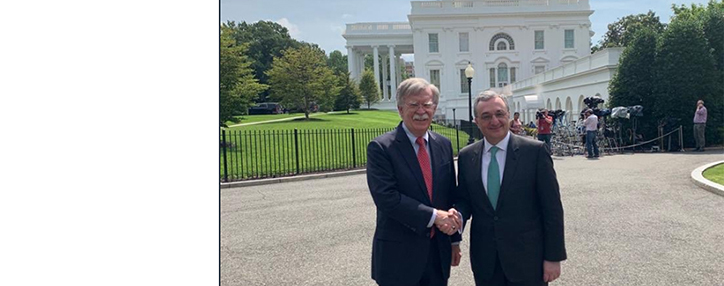
YEREVAN, June 21. /ARKA/. Armenian Foreign Minister Zohrab Mnatsakanyan met yesterday in Washington with US President’s National Security Advise John Bolton. "Pleased with positive, extensive and engaging discussion with Amb. Bolton on Nagorno Karabakh peaceful resolution process, Armenia's and regional peace and security agenda, as well as Armenia-US bilateral cooperation," Mnatsakanyan said in a Twitter post.
He also added that the United States plays important role as OSCE MG Co-Chair along with Russia and France.
A day earlier, John Bolton has expressed his intention to meet with Armenian and Azerbaijani foreign ministers. “Looking forward to meetings later this week with the Foreign Minister of Armenia and the Foreign Minister of Azerbaijan, to encourage continued dialogue between them. The United States stands ready to assist in advancing the cause of peace in the region,” Bolton wrote on Twitter.
It was reported earlier that a meeting brokered by the co-chairs was expected to be held in the United States' capital to discuss Karabakh conflict settlement.
On June 14, ahead of the meeting, the Armenian ministry of foreign affairs released a statement saying that «Azerbaijan’s continuous deplorable violations of ceasefire and provocative actions in recent days, which caused human irreversible losses and led to a serious escalation of the situation on the Line of Contact, have created unfavourable environment before the meeting.»
The Nagorno-Karabakh conflict erupted into armed clashes after the collapse of the Soviet Union in the early 1990s as the predominantly Armenian-populated enclave of Azerbaijan sought to secede from Azerbaijan and declared its independence backed by a successful referendum.
On May 12, 1994, the Bishkek cease-fire agreement put an end to the military operations. A truce was brokered by Russia in 1994, although no permanent peace agreement has been signed. Since then, Nagorno-Karabakh and several adjacent regions have been under the control of Armenian forces of Karabakh. Nagorno-Karabakh is the longest-running post-Soviet era conflict and has continued to simmer despite the relative peace of the past two decades, with snipers causing tens of deaths a year.
On April 2, 2016, Azerbaijan launched military assaults along the entire perimeter of its contact line with Nagorno-Karabakh. Four days later a cease-fire was reached. -0---
He also added that the United States plays important role as OSCE MG Co-Chair along with Russia and France.
A day earlier, John Bolton has expressed his intention to meet with Armenian and Azerbaijani foreign ministers. “Looking forward to meetings later this week with the Foreign Minister of Armenia and the Foreign Minister of Azerbaijan, to encourage continued dialogue between them. The United States stands ready to assist in advancing the cause of peace in the region,” Bolton wrote on Twitter.
It was reported earlier that a meeting brokered by the co-chairs was expected to be held in the United States' capital to discuss Karabakh conflict settlement.
On June 14, ahead of the meeting, the Armenian ministry of foreign affairs released a statement saying that «Azerbaijan’s continuous deplorable violations of ceasefire and provocative actions in recent days, which caused human irreversible losses and led to a serious escalation of the situation on the Line of Contact, have created unfavourable environment before the meeting.»
The Nagorno-Karabakh conflict erupted into armed clashes after the collapse of the Soviet Union in the early 1990s as the predominantly Armenian-populated enclave of Azerbaijan sought to secede from Azerbaijan and declared its independence backed by a successful referendum.
On May 12, 1994, the Bishkek cease-fire agreement put an end to the military operations. A truce was brokered by Russia in 1994, although no permanent peace agreement has been signed. Since then, Nagorno-Karabakh and several adjacent regions have been under the control of Armenian forces of Karabakh. Nagorno-Karabakh is the longest-running post-Soviet era conflict and has continued to simmer despite the relative peace of the past two decades, with snipers causing tens of deaths a year.
On April 2, 2016, Azerbaijan launched military assaults along the entire perimeter of its contact line with Nagorno-Karabakh. Four days later a cease-fire was reached. -0---