

Nalbandyan: Azerbaijan isolated again
25.05.2015,
16:26
Azerbaijan found itself in isolation again, Armenian Foreign Minister Edward Nalbandyan said in an interview with Radio Liberty as commented on Azerbaijan's disagreement on wording on Karabakh in the final document of the EU Eastern Partnership Riga Summit.
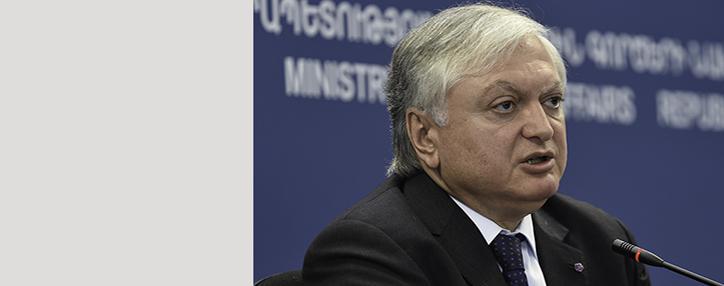
YEREVAN, May 25. /ARKA/. Azerbaijan found itself in isolation again, Armenian Foreign Minister Edward Nalbandyan said in an interview with Radio Liberty as commented on Azerbaijan's disagreement on wording on Karabakh in the final document of the EU Eastern Partnership Riga Summit.
«This time 28 countries were unanimous in insisting on inclusion of the language calling for support for OSCE Minsk Group co-chairs' efforts as well as the efforts of OSCE Minsk Group co-chair countries and the statements made since 2009 in the final declaration,» he said.
«I mean the statements made in L'Aquila, Muskoka, Deauville, Los Cabos and Enniskillen, in connection of which we have repeatedly said that our approaches are in tune with these statements, while Azerbaijan has said nothing about them yet.»
Nalbandyan said that this time the statements were included in the general declaration of EU and Eastern Partnership countries again, and Azerbaijan had some problems with this.
«Therefore, the foreign minister of Azerbaijan left the hall and attempts to bring him back failed,» the minister said in his interview.
«Finally, an accord was reached after negotiation – it was decided that the declaration will be adopted and Azerbaijan will submit its objections on the provision.»
Armenia and a major part of the international community, including the EU and Eastern Partnership countries, are unanimous on this issue, while Azerbaijan is in opposition again.
The Karabakh conflict broke out in 1988 when prevailingly Armenian population of Nagorno-Karabakh declared withdrawal from Azerbaijan.
In a referendum on December 10, 1991, 99.89% of Nagorno-Karabakh population voted for independence from Azerbaijan. Azerbaijan responded by large-scale military operations that led to loss of control not only over Nagorno-Karabakh itself, but also over seven adjoining areas.
About 25-30 thousand people were killed and about a million fled their homes during the military operations.
A trilateral cease-fire agreement was signed on May 12, 2004, and has been followed since then. The ongoing Karabakh peace process started in 1992 under auspices of OSCE Minsk Group co-chaired by the USA, Russia and France. ---0-----