


Aliyev Offers Armenia Energy Alternative to Russia: What's Behind His Attack on Armenian Nuclear Power Plant?
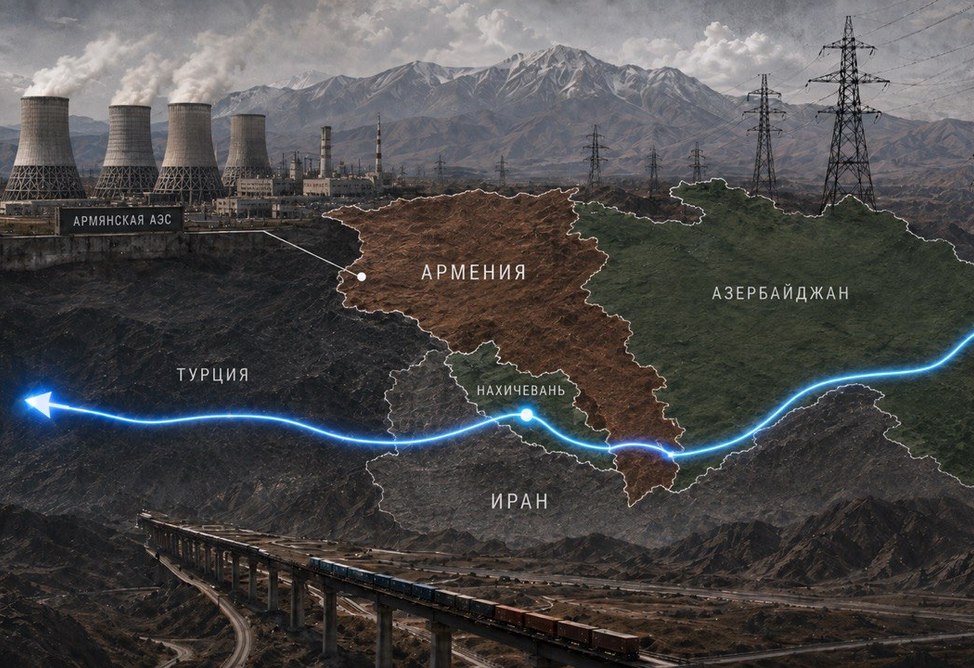
YEREVAN, August 13. /ARКА/. At first glance, Azerbaijani President Ilham Aliyev's remarks about the Armenian Nuclear Power Plant (ANPP) might seem like yet another attack by Baku against Armenia's nuclear energy sector. However, if one reads Aliyev's interview in its entirety and considers the current context of Armenian-Russian relations, a broader picture emerges.
This may not be solely about the ANPP, or even primarily about it. Aliyev is effectively offering Armenia a new energy and infrastructure architecture, in which the role of Azerbaijan, Turkey, and the US-backed TRIPP project increases, while Russia's traditional presence in the region is diminishing.
It is in this context that one should consider his prediction of a "complete energy crisis" in Armenia after the closure of the ANPP and his proposal to use Azerbaijani electricity as an additional source of energy.
Russia Failed – TRIPP Arrived
The context of the interview itself is quite revealing. Speaking about the opening of communications between mainland Azerbaijan and its exclave Nakhichevan through Armenia, Aliyev recalls the trilateral statement of Armenia, Azerbaijan, and Russia from November 2020, effectively placing some responsibility on Moscow for the failure of the transport project to be implemented.
According to Aliyev, Azerbaijan had repeatedly approached Russia and Armenia on this issue, but the Russian side "was either unable to ensure its implementation or had other reasons."
The Azerbaijani president then directly contrasted this with American involvement: according to him, after the US's involvement, the process was launched and eventually transformed into TRIPP. In other words, the logic of the interview is quite consistent: the mechanism involving Russia failed, while the mechanism involving the US worked. And only then did Aliyev shift from transport to energy.
Strike against ANPP
Aliyev stated that Azerbaijan had already prepared a plan to lay power lines from the mainland through Armenia to Nakhichevan. He then unexpectedly links this project to the future of the Armenian Nuclear Power Plant.
The President of Azerbaijan stated that Armenia's main source of energy is the nuclear power plant, which, he asserted, "is not under their control." He called the ANPP obsolete and a threat to the entire region, declaring that after its closure, Armenia would "be plunged into a complete energy crisis." As one option for increasing the resilience of the Armenian energy system, Aliyev proposes a future energy route through Armenia to Nakhichevan, Turkey, and then Europe.
Factually, a number of these assertions require direct refutation. The Armenian Nuclear Power Plant belongs to the Republic of Armenia and is managed within the Armenian state system. The participation of Russian companies in the modernization, technical support, and lifespan extension of the plant does not transfer ownership or state control over the ANPP to Russia.
The scheme presented by Aliyev, according to which the shutdown of the operating unit automatically leads the country to energy collapse, is also inconsistent with Armenia's official energy strategy. Armenia intends to extend the operation of its current power unit until 2036 and use this period to transition to a new nuclear model. The government has already made a fundamental decision to preserve nuclear energy as a key element of the country's energy security and to focus on small modular reactor technologies when selecting a new power unit.
The ANPP is indeed critical: it provides approximately a third of Armenia's electricity production. Its shutdown without a timely replacement would pose a serious risk to the energy system. However, this is precisely why the state strategy does not envisage abandoning nuclear energy, but rather replacing the existing capacity with new power.
The International Atomic Energy Agency's assertion that the operating ANPP poses a threat to the entire region, presented by Aliyev as established fact, has not been confirmed. The IAEA is involved in Armenia's nuclear safety programs, and the extension of the plant's operation is envisaged only if its safe operation is confirmed by appropriate studies and regulatory procedures.
The Russian factor is indeed behind the ANPP
However, it would be a mistake to completely separate Aliyev's statements from Russia. Although the ANPP is under Armenian control, Russia's role in its technological history and modernization remains significant. Rosatom participated in the plant's first lifespan extension program and is playing a significant role in the current phase of the second extension.
In the spring of 2026, Russian Deputy Prime Minister Alexey Overchuk stated that Russia was prepared to extend the ANPP's operation until 2036, but only if appropriate guarantees were provided: Rosatom, he stated, must receive at least 70% of the contracted work. At the same time, Overchuk publicly criticized Armenia's use of European contractors, citing this as a consequence of Yerevan's chosen "European vector."
In other words, Armenia's nuclear energy sector has already become a focal point for competition among various external players.
This was especially true after Armenia and the United States signed a peaceful nuclear cooperation agreement in February 2026, paving the way for the transfer of American nuclear technology and equipment. Russia reacted extremely sensitively to the prospect of American participation in the construction of the future Armenian nuclear power plant. Reuters viewed this discussion, among other things, as a struggle between Moscow and Washington for influence in the South Caucasus. Against this backdrop, Aliyev's statement that the current ANPP is allegedly "not under Armenia's control" takes on added meaning. Formally, this assertion is incorrect. But politically, it can be read as a hint at the Armenian nuclear industry's dependence on Russian technology and specialists, and simultaneously as a proposal for a different model of energy relations.
Moscow itself is heightening the debate about Armenia's choice
This development is unfolding against the backdrop of a sharp deterioration in relations between Yerevan and Moscow. In 2026, Russian restrictions affected a wide range of Armenian goods, including agricultural products, flowers, fish, alcohol, and several other categories. The Russian side explained these measures by citing sanitary and regulatory reasons.
The Armenian government, however, officially stated that restrictions on the export of goods of Armenian origin contradict the bilateral legal framework and EAEU norms.
The European Union went further and publicly described the situation as economic pressure on Armenia, while simultaneously offering Yerevan additional financial assistance and greater access for Armenian goods to the European market.
Reuters also viewed the Russian trade restrictions in the context of the political cooling between Moscow and Yerevan and Armenia's move toward the EU.
Simultaneously, four EAEU member states—Russia, Belarus, Kazakhstan, and Kyrgyzstan—called on Armenia in May to hold a national referendum "as soon as possible" and choose between joining the European Union and maintaining its membership in the EAEU. They also instructed that an assessment of the possible consequences of suspending the EAEU treaty for Armenia be prepared by December.
Yerevan rejected this logic. Pashinyan stated that a referendum on EU accession would only make practical sense after Armenia officially submits an application for membership and the issue becomes substantive. At the same time, Armenia's participation in the CSTO remains frozen. Russian leaders are already openly raising the question of Yerevan's future in both the CSTO and the EAEU.
Thus, Moscow itself is increasingly confronting Armenia with the question of geopolitical and economic choices. And it is at this point that Aliyev's proposal emerges. Against this backdrop, the energy portion of the Azerbaijani president's interview appears significantly broader than the usual discussion of power transmission lines.
Aliyev proposes building an infrastructure corridor through Armenia, including not only a railway and road, but also power transmission lines, fiber-optic lines, and, potentially, oil and gas pipelines. This route would connect Azerbaijan with Nakhchivan, Turkey, and European markets and become part of the US-backed TRIPP project.
At the same time, Azerbaijan seeks not only to transit electricity through Armenia but also to position itself as a potential supplier to the Armenian energy system itself.
This is where the most interesting geopolitical question arises. While today a significant portion of Armenia's energy ties are historically tied to Russia—from gas supplies to Rosatom's participation in the nuclear industry—the model proposed by Aliyev creates an additional axis: Azerbaijan-Armenia-Nakhchivan-Turkey-Europe, all under the political umbrella of the American TRIPP.
This doesn't mean that one system will automatically replace the other. But such an infrastructure could potentially reduce Armenia's dependence on one external direction while simultaneously strengthening the role of Azerbaijan and Turkey in the energy architecture of the South Caucasus.
Aliyev is exploiting a window of opportunity
Can it be argued that Aliyev's attack on the ANPP is aimed at Russia? There is no direct evidence of such a motive. But the consistency of his own reasoning allows this version to be considered a fully justified analytical hypothesis.
First, Aliyev says that Russia failed to ensure the implementation of the transport agreements. Then he emphasizes that it was US intervention that made it possible to launch the new TRIPP format. Following this, he questions Armenia's energy independence, attacks the Armenian Nuclear Power Plant, and immediately proposes an alternative—an energy route linking Azerbaijan, Armenia, Turkey, and Europe.
All this is happening at a time when Moscow is exerting increasingly significant economic and political pressure on Yerevan due to Armenia's European course, when relations with the CSTO are effectively frozen, and the United States is simultaneously involved in both the country's transportation and nuclear agendas.
In this configuration, Aliyev appears to be attempting to take advantage of the emerging geopolitical window: offering Armenia an infrastructure model that objectively reduces the exclusivity of Russia's presence while simultaneously making Azerbaijan a key participant in the future regional energy system.
ARKA Editorial Column.-0-
