


Between Record Highs and Rising Risks: How the CEO of an Investment Firm Sees the Market
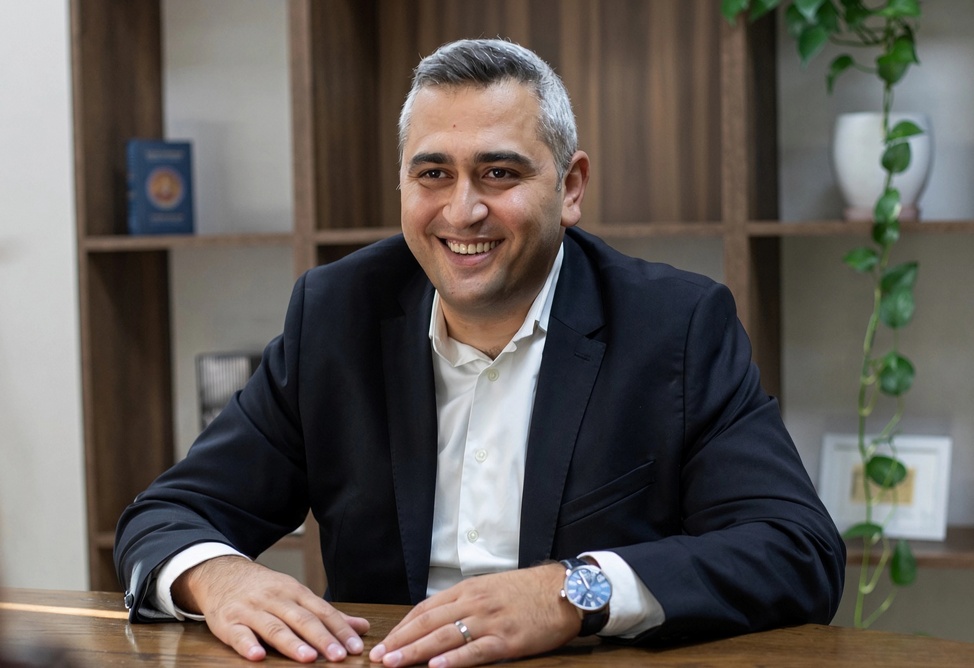
YEREVAN, September 7. /ARKA/. Global markets continue to rise against the backdrop of strong corporate earnings, yet at the same time questions are mounting — about the sustainability of that growth, the risks of high valuations, and where the vulnerabilities may lie.
We asked Gor Gevorgyan, Chief Executive Officer of the investment firm Landmark Capital, to share his perspective on the current state of markets, risks, and opportunities.
1. We are witnessing a sustained rise in equity markets, despite a whole range of factors that in other periods might have triggered serious correction. Why is the market ignoring the risks?
I would not say the market is ignoring the risks. There are indeed many risks, and investors are fully aware of them — they simply do not yet see their impact on corporate profits and economic growth. And the figures speak for themselves: in the second quarter, earnings growth among S&P 500 companies was substantial. True, some of the key figures were driven by gains from the revaluation of investments in AI companies, but even if you exclude that factor, earnings growth remains above 30%. At the same time, the growth is not concentrated exclusively in a handful of technology companies — profits are rising across different sectors of the economy.
The second important point is the resilience of the economy. Since COVID-19, we have repeatedly heard warnings of an impending recession, economic crisis, market collapse. Yet none of that has materialized. Yes, after COVID-19 refinancing rates rose significantly because of high inflation, and still the economy kept growing and is still growing.
Interestingly, this is not a cheap-money rally: interest rates remain fairly high, the yield on 10-year U.S. Treasuries is now around 4.7%, and the 30-year is above 5%. Despite that, stock prices are holding near record highs. That shows how strong the market’s confidence in future earnings is.
I will make an important caveat: a strong market does not mean a cheap market. The forward P/E ratio stands at about 20. Investors are paying a rather high price for future growth. So, my position is this: the market’s optimism is well‑founded but the current valuation leaves increasingly little room for error, and that, in my view, is where the main vulnerability of the current bullish scenario lies.
2. If the positive scenario turns out to be wrong, what will be its weak point? Which factor could truly shift investor sentiment, and do you already see such a risk today?
If I had to single out the main risk, from my point of view it is neither geopolitics nor even a possible recession. The most vulnerable aspect of the current positive market scenario is the combination of high investor valuations and high long-term interest rates.
Today investors are paying a high price for equities because they expect further growth in corporate profits. Therefore, a material correction does not require a recession or a shock; sometimes it is enough for reality to come in slightly worse than expectations.
The most dangerous scenario would be one in which a slowdown in earnings growth and the persistence — or further rise — of long-term rates at a high level appear at the same time. That hits stocks from different sides: lower profits reduce the investor’s return, while high bond yields raise the discount rate. If both factors coincide, the market gets both downward revisions to earnings forecasts and a compression of multiples.
There is also an underestimated fiscal risk: long-term bond yields are not determined by Federal Reserve policy alone. The budget deficit and the scale of issuance can themselves keep yields high even if the Federal Reserve policy continues to cut the refinancing rate. In other words, you can have a situation where the economy slows but 10- and 30-year yields do not decline as quickly as the equity market expects.
Another risk concerns the effectiveness of the investment cycle in the AI industry. Companies are putting billions into data centers, chips, energy, and infrastructure, and the market assumes those investments will pay off. The key question is what ROI they generate. If capital expenditures keep rising while monetization lags, that can hit not only the valuations of a few technology companies but the entire market, because AI is now one of the main drivers of economic growth and of earnings growth. That said, I do not yet see confirmation of a bearish scenario: corporate profits remain resilient, economic activity is growing, and there are no signs of stress in the credit market. For me, the key indicators are the direction of earnings-estimate revisions, the behavior of long-term U.S. Treasury yields, and the dynamics of credit spreads. If at least two of these three factors start to deteriorate simultaneously, that will be a sign that the fundamental equilibrium supporting the current bullish scenario is breaking down.
3. Is there a widespread investor belief today with which you fundamentally disagree? What, in your view, is the market currently mispricing?
My view diverges from the market consensus in two directions. The first concerns AI. I do not share the belief that the risks of the current enormous investment cycle are automatically offset by equally high returns for shareholders. That said, I am not saying AI is a bubble— it is a profound technological breakthrough. But the mere fact of real progress does not guarantee that its benefits will be distributed evenly among companies, or that the long-term benefit will accrue specifically to technology companies.
Today we see billions flowing into the AI industry, and the market is saturated with promises. In my view, the main question we will soon hear is what is happening with ROI. I am much more interested in companies that are already generating real cash flow from the AI investment cycle than in those whose valuation rests only on future expectations of monetization. Moreover, I believe a significant share of the benefits will, over time, accrue to companies in other sectors — finance, healthcare, industry — that are already using AI. The paradox is that the market has yet to fully price in the future economic gains of such companies.
The second direction is long-term U.S. government bonds. Today those yields are holding at a high level, which for the market means a “higher for longer” scenario — because of fiscal deficits, a large volume of issuance, a high term premium, and inflation-related risks. I acknowledge those risks, but I believe that over a horizon of several years long-term U.S. Treasuries offer an attractive risk-reward: if yields stay at current levels, the investor continues to receive a high coupon and carry; if inflation normalizes and yields fall, that produces a substantial capital gain through the duration effect.
That is why I try to distinguish narrative from the valuation. Today’s narrative is negative — public debt, deficits, “higher for longer.” Yet attractive risk premia often emerge precisely when the market has already been priced in excessive negativity.
4. If we take the global picture and apply it to Armenia: where do you see opportunities that the market is still underestimating?
In recent years Armenia has seen steady economic growth: a strong economy, large financial assets, significant private capital. But the economy is still financed through bank loans. That gap is exactly where the main underappreciated opportunity lies as the economy grows, other channels need to be expanded — corporate bonds, equity financing, private financing, structured products, and, over time, a more active IPO market.
Insufficient financial literacy among the population is often cited as the main brake on the development of the capital market. I disagree. The main problem of our market is liquidity. And liquidity is not created by retail investment: private investors arrive in an already formed market; they do not form it themselves. Market liquidity must be provided by banks and investment firms, including Landmark Capital; we understand that responsibility.
I want to emphasize that Armenia faces no problems with either infrastructure or legislation when it comes to developing the capital market. The challenge lies in implementing what is already embedded in those frameworks. We concentrate mainly on Armenian bonds or assets affiliated with Armenia. But what stops us from going into Western markets and offering what Western markets and Western investment funds offer? These could be funds, ETFs, and other relatively conservative instruments with high liquidity- since for investors, liquidity is the primary concern. Profitability and the rest come after that. I realize this is a long story, measured in decades, yet at some point you must start, at some point you must leave the deposit/loan logic, otherwise the capital market will remain a banking market.
I cannot fail to mention government bonds: our Eurobonds currently yield around 6.1–6.2% while 10-year U.S. Treasuries yield about 4.7%. That is a historically tight spread, indicating that in the eyes of foreign investors Armenia looks like a low-risk country.
The second direction I would highlight is Armenia as a regional financial hub. A small domestic market is not the main constraint for financial services if you build infrastructure of international quality. All the more so in the current geopolitical situation, when capital and business are looking precisely for jurisdictions that can provide stability within the international financial system.
5. Imagine that today you must invest your own capital for a five-year horizon. What would you buy — would you prefer to buy at current levels or wait for a correction?
I would note that we are already investing — Landmark Capital as an institutional investor, and I as a private individual invest my savings. But if we assume I had to do it right now, I will never commit the entire amount at once: I would invest 10–30% and keep the rest in anticipation of a real correction. Five years is a long horizon, and in my view within that period a more attractive entry point into the market is quite likely to emerge.
As a representative of the old school, I prefer the classic 60/40 portfolio. The majority would be equities, but the choice would be selective: companies with a solid balance sheet, stable free cash flow, high ROI. I remain positive on AI, but I do not believe that any company connected with AI automatically deserves its price — what is interesting are those already showing real cash flow and productivity gains.
The second major component would be long-term U.S. Treasuries. I have already said that I am aware of all the risks, and nevertheless, on a five-year horizon their yields appear attractive to me.
I would keep part of the capital in cash equivalents — bills, notes — because that is the ability to always be ready for a correction. I have predefined correction levels for adding to positions. But the key here is not the correction itself, but its cause: a decline driven by downward earnings revisions does not always make stocks cheaper, while a decline driven by panic is almost always a good entry point.
I can say that I am cautious about highly leveraged companies — at high rates, leverage becomes genuinely expensive — and I do not build a portfolio around a single macro forecast: that the Fed will cut rates, that the AI boom will continue, or that there will be no recession.
6. Which asset would you never buy?
There is no such asset. It always comes down to price, liquidity, and growth forecasts. I once thought I would never engage in commodity trading. But two years ago, given the geopolitical situation and the movement of interest rates, I bought a gold ETF- not at the very peak of the cycle. And I am ready to do the same with other assets.
7. If we recall how we started this conversation, we keep coming back to the same things: there is price, there is risk, there is liquidity, there is profit, and there is the investment horizon.
Yes, because ultimately these are what matter for any investor — whether global markets or local ones, institutional or private investments. Markets, circumstances, and technologies will change, but the core principles of investing will remain unchanged.
Partner material. The opinions and assessments expressed in the interview are those of the interviewee. The information in this material is for informational purposes only and does not constitute individual investment advice or an offer to buy or sell any financial instrument. Investing involves risk, including the risk of losing your investment. Past performance does not guarantee future returns.